The Backbone of Protestant Missions?
I have long believed that the backbone of Protestant mission advancement throughout the world has been the single woman. Most libraries of the person with a heart towards missions include a biography of Amy Carmichael, Lottie Moon, Gladys Aylward and Mary Slessor. These women were from four different countries (Ireland, the United States, England and Scotland) and served in three different countries (India, China, and Nigeria).
Carmichael is known for her native dress and saving girls from being trafficked. Moon followed her younger sister to China at age 32, only to be assigned as schoolteacher, when her gift was evangelism. She became influential in challenging the limited roles that women were perceived to desire. Aylward was told she would never be an acceptable missionary and then her life made such an impact, Hollywood made a movie about it (The Inn of the Sixth Happiness, though Aylward was not happy with the license Hollywood took with her life). And Slessor saved hundreds of sets of twins in Nigeria and helped to stop the cultural practice of leaving them out to die. She is remembered still in the region as “the white Queen of Okoyong.”

Amy Carmichael with children in India
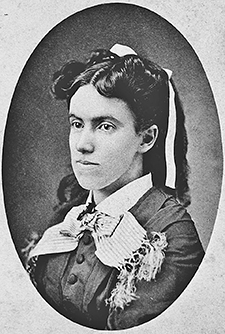
Lottie Moon
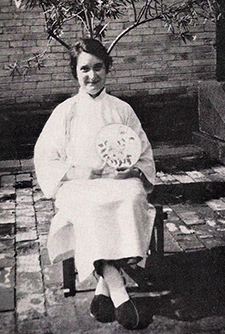
Gladys Aylward

Mary Slessor
Photo credits for above images: Amy Carmichael with children in India [By Aishwarya A – Heroes of Faith, Public Domain, https://commons.wikimedia.org/w/index.php?curid=2938723]; Lottie Moon [Public Domain, https://commons.wikimedia.org/w/index.php?curid=3980797; Gladys Aylward [Public Domain, https://commons.wikimedia.org/w/index.php?curid=15582916]; and Mary Slessor [Public Domain, https://commons.wikimedia.org/w/index.php?curid=21099901].
What Is a SWF Missionary?
From an article on single women missionaries, Maggie Watts of Serving In Mission (SIM) writes, “According to data from Pioneers (the mission agency), single female missionaries have vastly outnumbered single men since 1900. Pioneers also reports that 70 – 80 percent of single missionaries are women.”
That’s really not a surprise, even in 2026. Women are still considered an inferior sex, regulated to be behind veils, walls or men. But that very “weakness” is what must be the strength that Paul writes about in 2 Corinthians 12:10, “That is why, for Christ’s sake, I delight in weaknesses, in insults, in hardships, in persecutions, in difficulties. For when I am weak, then I am strong.” Though, to be honest, that is easier said as a man than to endure as a woman.
The single white female (SWF) missionary is a conundrum, a riddle, a puzzle to her family. As an adult she spends most of her life in another country, among another people, speaking another language. Seldom do family members consider visiting her, to experience first-hand what her life is like when not on furlough. She is expected to remember people and places that have not been a part of her life for years. Upon her death, her albums of photos from a life of work, don’t carry the same significance to those left behind.
A Mystery
This is what happened in the early 2000’s. I came to work as the regional representative for the Prayer League (WMPL) in the Pacific Northwest. Part of that work assignment was to be the mission rep at a local Bible school. When that school moved, an album of photos was presented to me, assuming that the woman featured was connected with our mission. She wasn’t. There was no name listed on the album. There was no mission named either, though it was obvious that this was a missionary. It felt … wrong … to throw the album away.
So, I decided to celebrate her. I don’t know her name, I don’t know her exact title, or where she served. But I loved the idea of remembering her and making up a story to go with the photos. For years the accompanying pictures have been in the bedroom of the guest apartment attached to our house. Here is the story of a single white female missionary I’ve named “Sarah Winifred Friendly.”
The Old Photo Album Tells the Story of “Sarah”
“Sarah Winifred Friendly” began her missionary career in the 1910’s the way all missionaries do—with language study. Her teacher was exacting, but fair, as she knew that this wouldn’t be the only language she would be learning. Hindi was the trade language. The local one would be determined once she arrived at her assignment.

Language learning – “Our” SWF missionary, “Sarah Winifred Friendly”, is in the center – circa 1910s
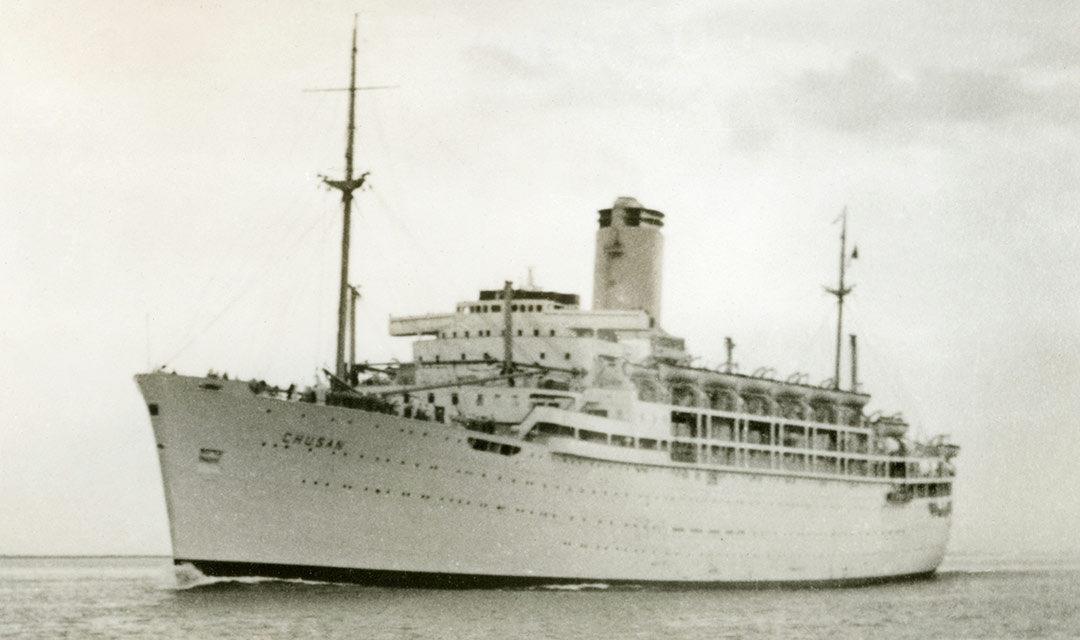
In the 1910’s the only way to get to the field was by ship. Casting off to sail meant the last glimpse of family for many missionaries.
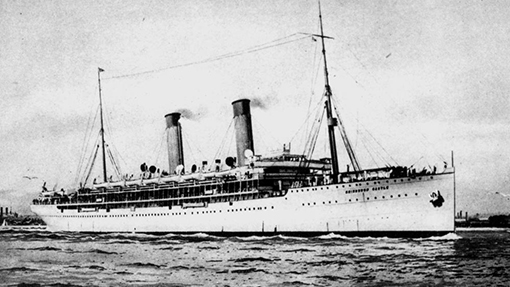
Ship, circa 1910 [Public domain, via Wikimedia Commons]
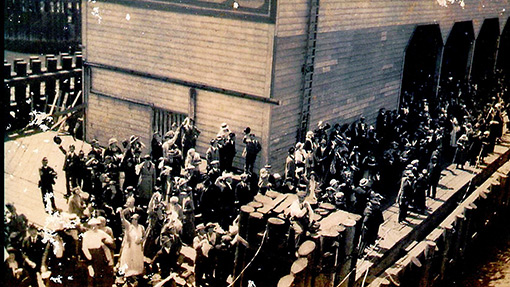
This was generally the last glimpse of family for many missionaries as the ship pulled away from the dock
In 1911, “Sarah” was assigned to a dispensary among one of the tribes. The women dressed in saris, the men in lungis (men’s skirt similar to a sarong, usually multicolored and tied around lower waist), and the foreigners in long skirts and high necklines. Young boys were allowed to run naked.

“Sarah” at the dispensary, 1911
“Sarah” was careful with her reporting as accurate numbers were required to be reported back to the home mission.
It becomes a little clearer what “Sarah’s” assignment most likely was as she poses with these babies – perhaps they are twins? I would assume that she was a doctor, either an OB-Gyn or a pediatrician. I also assume she was accepted as MD in India, though she would have had a hard time practicing in the United States at that time (early 1900’s).
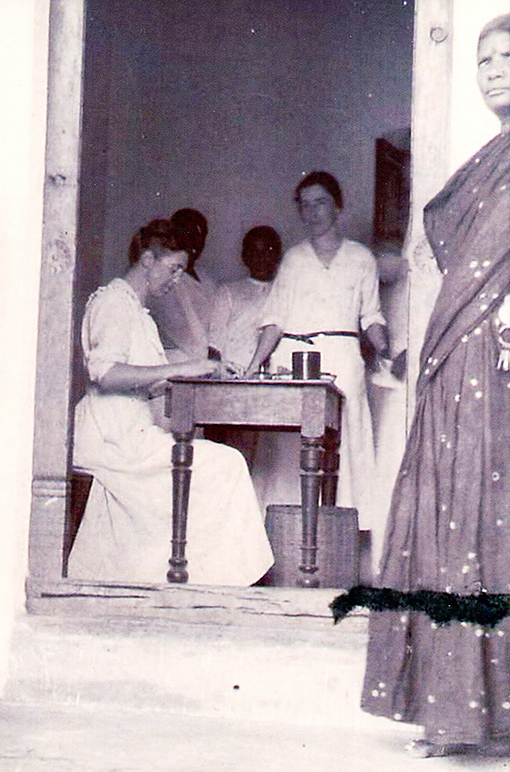
“Sarah” at work, most likely in the dispensary
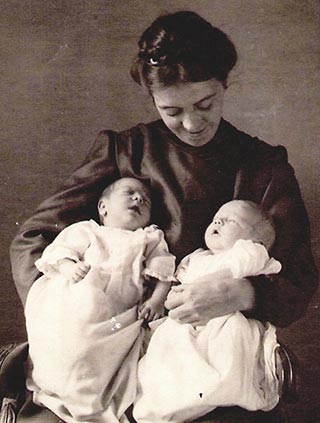
“Sarah” was probably a doctor – either an OB-Gyn or a pediatrician. We can assume she was accepted as MD in India, though not “here” in the U.S.

“Sarah” with more babies and children – most likely abandoned little girls
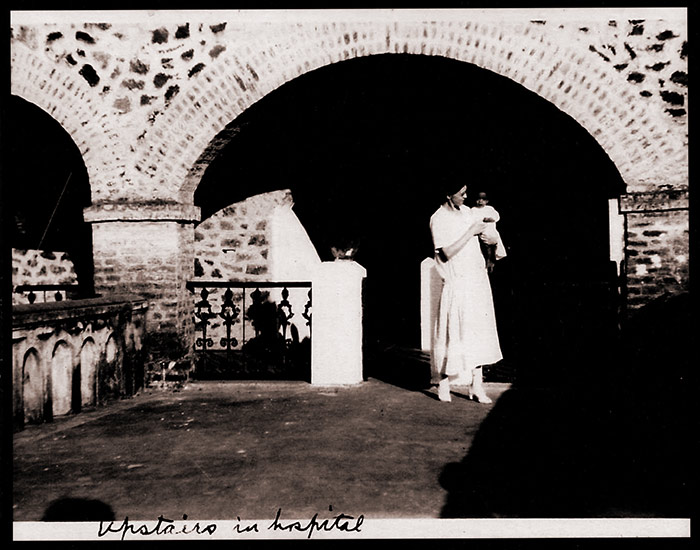
“Sarah” upstairs in the hospital – the hemline suggests that this is circa 1920s
After her first furlough, “Sarah” returned to the hospital grateful to adopt a shorter hemline, a more relaxed waistline and shorter sleeves. The fashion of the 1920’s made it easier to stroll in hot humid weather with one of the babies in her care.
All the single missionaries would probably live in this beautiful home in Ramachendrapur. The traditional thatched roof would have been common in rural areas and made of local materials such as dried grass, reeds or palm leaves. This roof would provide good insulation against the ever-present heat.
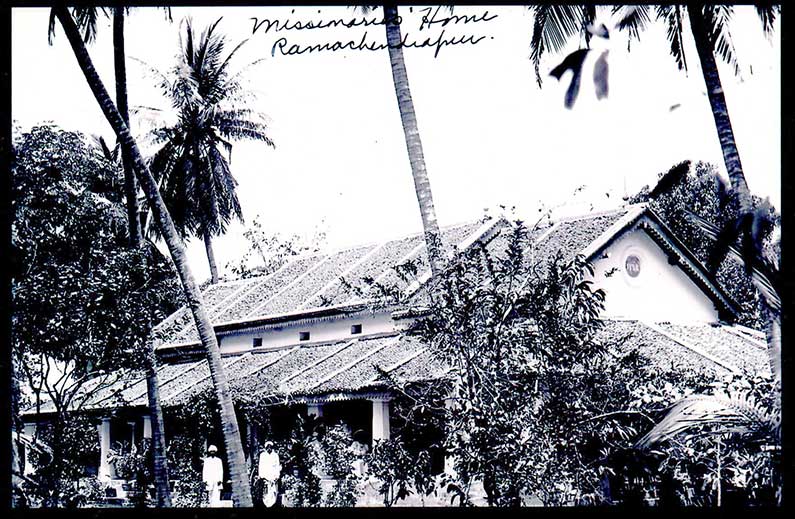
“Sarah’s” home in Ramachendrapur – most likes shared with many others
Besides the dispensary, the mission most likely ran an orphanage, and it probably mainly housed girls. This gift of mercy kept many girls from starvation or prostitution. It was most likely that these girls soon became helpers at the hospital. Aunties, nursing students and the local village helped with the care of so many babies. But it was always a joy just to sit with a sleeping child in ones arms.
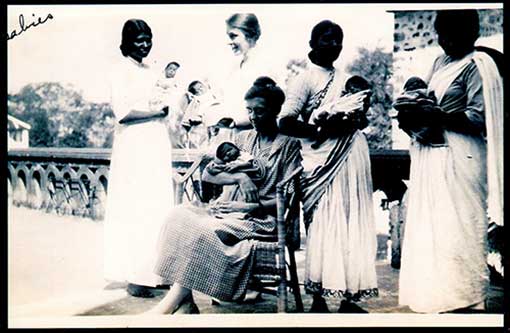
Babies and aunties – probably nursing students or nurses trained by “Sarah”
By the 1950’s “Sarah” had spent her career in rural India. The dispensary had grown into a hospital, one with separate wings and more than one floor! Though I can’t verify my story, I googled ‘Ramachendrapur in India’. Unfortunately, there are several hospitals with that name in West Bengal. The pictures don’t look like the one from the 1950’s, but the hospitals receive top praise.
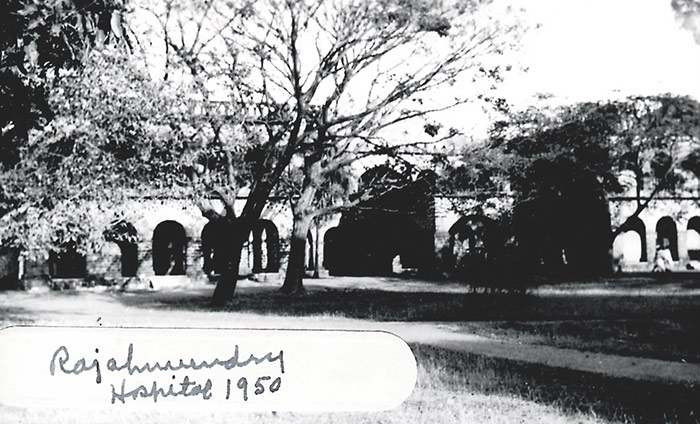
Hospital, 1950
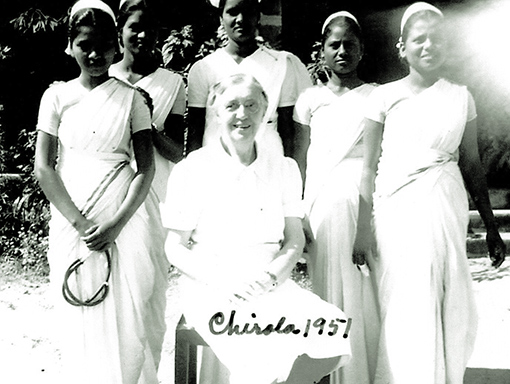
“Sarah” with nursing students, probably from a program she started, 1951
Upon retirement “Sarah” poses one last time with the latest class of nursing students. These girls are proud to pose with their teacher, knowing that because of the training they have received from her their futures will be much more secure.
Unknown, But Not Forgotten!
I think “Dr. Sarah Winifred Friendly” would be proud of the legacy she left in India. I imagine that before sailing for that first mission term, “Sarah” had claimed John 3:30 as her life verse, “He must increase, but I must decrease.” (NASB) Though no one knows her name, nor where she is from, the photos in that old album are a testimonial that “Sarah” lived that verse well.
For more information about World Mission Prayer League, go to: wmpl.org